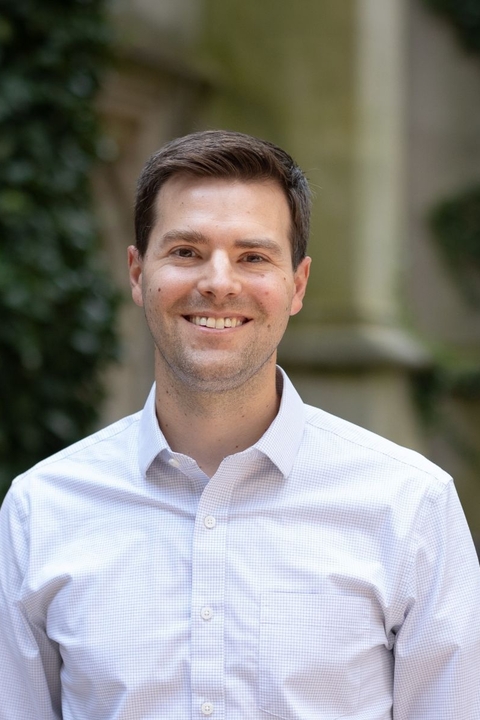
FPE: What’s your favorite course to teach, and why?
Ryan: My favorite course to teach is called “Eco-Futures: Theology, Ethics, and Imagination.” The course grew out my attempt to walk with students who are attuned to and deeply troubled by the climate and ecological crises. I found that many students’ experiences of this moment are shaped – sometimes explicitly but usually implicitly – by narratives they have absorbed about what is coming in the future. I decided to create a course that would challenge us to make our imagined stories explicit and consider what other stories about the future are possible.
While the course topics are sometimes heavy, I love to teach it because it centers fiction and storytelling. We read sci-fi, Afrofuturism, Indigenous Futurism, Solarpunk, and more. The fiction is always paired with ethical and theological texts that help us reflect on its themes. We move gradually from thinking near-term climate futures to deeptime and eschatological futures. Whatever difference the course has made for students, it has certainly been of value to me.
FPE: How did you get interested in the extinction of species as an ethical problem?
Ryan: In 2020, I was a postdoc at the University Center for Human Values at Princeton. I was teaching courses on religion and environmental ethics. When COVID hit and classes went online, UCHV restructured teaching, assigning more faculty to fewer classes. I was paired with Peter Singer and David Wilcove (a conservation biologist) on a class called “Ethical Issues in Environmental Policy.”
Wilcove, who has spent much of his career working to save species, brought questions about extinction to the center of the class. In terms of ethics, Singer’s animal-inclusive utilitarianism held the spotlight. I was fascinated by this conjunction as the class wrestled with the inability of Singer’s ethics to say that extinction matters ethically (except insofar as it causes an increase in pain among sentient beings, which it may not always do). While many students seemed to absorb aspects of Singer’s thought, I could see how deeply dissatisfied they were with the inability to say that the loss of a species truly matters. I became fascinated first by the question of why extinction matters and then by a host of other complex ethical issues presented by this moment of accelerating species extinction.
FPE: Your current project is on multispecies justice, which is a term that might not be familiar to a lot of people. What is multispecies justice, and why does it matter?
Ryan: As I’ve sought to find ways to speak ethically about what may be an emerging mass extinction event, I’ve been increasingly drawn to the language of multispecies justice, which is an emerging term across several fields in the environmental humanities. I think it is important that we consider how the category of justice, which is central to the Christian ethical tradition and to public moral discourse, might be applicable to our relations with and structures that affect our nonhuman kin. Justice is the ethical category most germane to engaging issues of public, institutional, and structural significance. While I continue to believe in the importance of some of the categories that have played a central role in environmental ethics (e.g., intrinsic value, creation care), I think we need to increasingly foreground justice – justice for human beings, to be sure, but not only for human beings.
The idea that justice might be relevant to our relations with nonhuman creatures – including not only personal but also institutional and structural relations – is a challenging one to develop because it departs in key respects from inherited traditions. How we might do so and what it would mean practically in this era of extinction are the questions with which I am currently dwelling. If any FPE members read this and are interested in similar questions, please reach out!
FPE: Your first book, The Best Effect: Theology and the Origins of Consequentialism, is a detailed intellectual history of how Christians writing before Bentham wrestled with the ethics of causes and consequences. What do people in the twenty-first century have to learn from their reflections?
Ryan: First, we simply need to learn that they existed. We often tell the story of consequentialism in general and utilitarianism in particular as an innovation of secular thinkers during the Enlightenment. Consequentialism, in this telling, is what you get when you strip away religion and tradition and think ethics in purely this-worldly terms. In reality, the major elements of utilitarian thinking were developed by Christian moralists writing in explicitly theological terms well before the classical utilitarians. That is interesting – and, for many, puzzling – in itself, and it should make us question the stories we have been told.
One of the things I love about historical work – and one of the reasons I wanted to do a more historical book first – is that historical work challenges presuppositions and helps us to see the contingencies of our own ways of thinking. One of the aspects of the story of consequentialism that most interests me is the way modern notions of efficient causation, which become dominant in the natural philosophy of the period, made their way into central ethical categories like agency and ends. The legacy of these developments is still with us – still, I think, shaping how we think in ways that we rarely consider. I see it most notably in debates about individual responsibility for large-scale social and structural harms like climate change.
FPE: You’ve been in the FPE since 2016. What has this community meant to you?
Ryan: Many things, but one above all: friendship. I attended the very first FPE gathering the summer after I completed my exams. I’ve attended the majority of gatherings since, and now, sadly, I’m “graduating.” Nothing has been more important than the many friends I have made along the way. By sticking around so long, I got to know what I think of as several “generations” of ethicists. Some of those with whom I began are approaching a more senior status in the field. Others that I met in recent years are still graduate students. My thought and practice – and my professional wellbeing – have been significantly enhanced by this network of friends. These friendships were especially important during the years I spent in contingent positions. I encourage people to continue with FPE for all the years available to you and attend the symposium when possible. The fruits of doing so become increasingly evident over time.